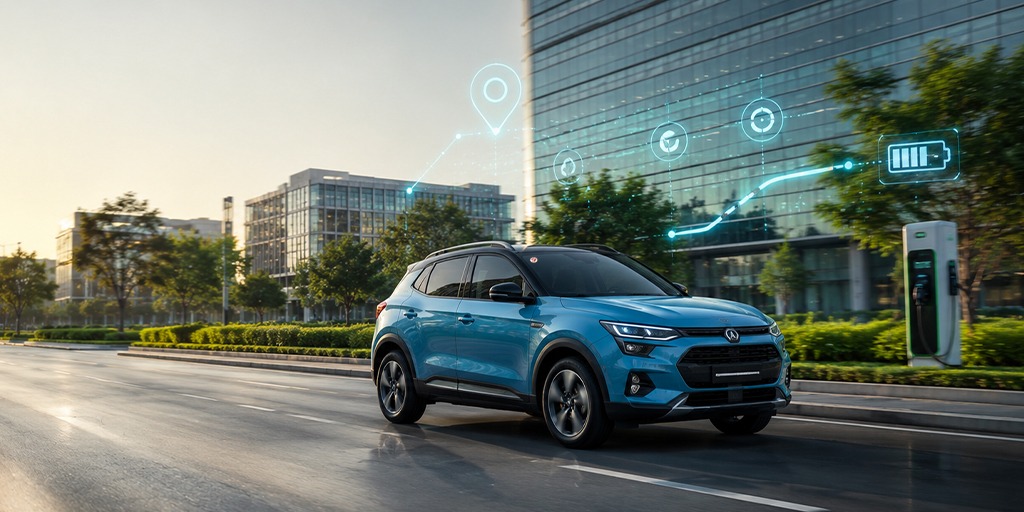
For decades, “corporate transportation” meant a fleet of cars, a maintenance schedule and a fuel card. But that model is being rewritten and India is very much part of the story. Electric vehicles and smart mobility platforms, increasingly supported by intelligent software, are converging to change how businesses move people and goods. Organisations that get ahead of this shift, whether they own their fleet outright or rely on corporate car rental and flexible leasing, are unlocking real cost and competitive advantages.
The scale of the opportunity is significant. Corporate fleets account for a large share of new vehicle sales worldwide. Industry research suggests that electrifying corporate fleets between 2025 and 2030 could avoid approximately one billion tonnes of CO2 emissions. While generating close to 246 billion euros in cumulative operational savings globally. In India, that global shift is playing out at speed, with its own drivers, challenges and opportunities.
EVs Are Becoming a Smarter Business Choice
For years, EV adoption was driven largely by sustainability commitments and government incentives. That is changing. As one fleet industry executive quotes, “the EV market in 2026 is defined by simple economics.” Fleets are adopting EVs as they cost less to operate and deliver durable value over time.
The numbers back this up. For high-utilisation corporate fleets, battery electric vehicles are now delivering operating costs 20 to 50% lower than internal combustion equivalents, driven by cheaper energy and lower maintenance needs. For trucks, where operating costs can represent 60 to 75% of the total cost of ownership, the savings are even more substantial.
That said, the transition is not uniform and a few realities matter for decision makers:
- Hybrids as a Bridge: Plug-in hybrids have grown faster than pure EVs in several markets recently. It offers fleets a way to reduce emissions and fuel costs without committing to large charging infrastructure projects. The catch is that hybrids only deliver their benefits if drivers actually plug them in.
- Infrastructure is the real bottleneck: Grid capacity, permitting delays and site planning remain the biggest obstacles to scaling EV fleets in most markets, more than vehicle availability or price.
- Emerging Valuable Additions: Smart charging and vehicle-to-grid technology are emerging value creators. This technology allows idle EVs to feed stored energy back into the grid during peak demand, helping fleet operators offset costs.
- Policy is a moving target: Regulations and subsidy structures continue to shift globally, which means fleets need electrification strategies flexible enough to survive changing incentives rather than betting everything on them.
India’s EV Story Is Accelerating Fast
India’s own electric vehicle journey has moved well beyond the early adopter stage and corporate fleets are a big part of this. EV sales in India crossed around 24.5 lakh units in FY2025 to 26, marking close to 25% year on year growth, with overall EV penetration reaching around 8 to 8.5% of total vehicle sales. Two-wheelers and three-wheelers still dominate volumes. But the commercial and corporate side of the market is where things are getting genuinely interesting.
A few trends stand out for Indian businesses:
- Logistics and delivery fleets are leading the charge: Electric commercial vehicles saw over 100% growth in FY2025 to 26, with e-commerce and logistics players expanding electric fleets to cut running costs and meet ESG targets.
- Corporate employee transport is going electric in tech hubs: Cities such as Bengaluru and Hyderabad are seeing a rise in electrified corporate fleets for employee transport, often supported by leasing and corporate car rental providers offering ready-to-use EV options.
- Charging infrastructure is catching up quickly: India had over 29,000 public charging stations by the end of 2025, with Karnataka leading the way and GST on EVs and chargers has been cut sharply to encourage faster adoption.
- State-level policy is shaping regional momentum. Cities like Delhi, Mumbai and Bangalore are rolling out EV-heavy policies. While states such as Kerala and Karnataka already show some of the highest EV penetration in the country.
For Indian businesses, this means the case for switching to EVs is no longer just about future-proofing. It is increasingly about cost and staying ahead of where fleet regulation and city planning are clearly headed. This is exactly where flexible corporate car rental fits in well, letting companies trial EVs on real Indian routes and traffic conditions before making a long-term commitment.
Smart Mobility Means Rethinking Ownership Itself
Perhaps the most structural shift is happening in how companies think about vehicle access altogether. Rather than buying or committing to long-term leases for every vehicle, businesses are increasingly turning to flexible acquisition models, including corporate car rental subscriptions, short-term hire and mobility budgets. It allows the employees to choose the right mode of transport for a given trip.
This mobility-as-a-service mindset extends well beyond cars:
- Micromobility: such as e-bikes and scooters, is filling last-mile gaps in urban commuting and on corporate campuses, particularly in dense Indian cities.
- Flexible fleet models: including corporate car rental and monthly subscriptions, allow businesses to scale up or down as needed. Test electric vehicles before committing capital and avoid being locked into vehicles that no longer match business needs.
- Unified digital platforms: they are pulling ride-hailing, rental fleets and public transport data into single dashboards. Companies can now manage employee mobility similar to any other operational expense.
The underlying shift is from asset ownership to mobility access, a more flexible and cost-effective way to move people and goods. For Indian businesses managing seasonal demand, client visits across cities or fleets that need to flex month to month, corporate car rental has become a practical middle ground between full ownership and doing nothing at all.
Technology Is Tying It All Together
Underpinning both of these shifts is a layer of smarter, connected technology. Modern fleet platforms combine telematics, maintenance data and financial systems into a single view. It provides managers with real-time visibility into vehicle health, driver behaviour and route performance.
A few areas where this technology is delivering measurable value:
- Route and dispatch optimisation: recalculates the most efficient routes based on traffic, weather and delivery windows. It matters enormously in congested cities where routing efficiency can make or break delivery timelines.
- Predictive maintenance: flags issues before they cause breakdowns rather than relying on fixed service intervals. This reduces downtime and repair costs across both owned and corporate car rental fleets.
- Driver safety and behaviour monitoring: identifies risky driving patterns such as harsh braking or speeding. It helps reduce accident rates and insurance costs.
- Automated ESG and compliance reporting: increasingly demanded by regulators and corporate customers. Fleets with automated reporting from their management platform have a clear edge in procurement and compliance processes.
The real transformation is not EVs, smart mobility or connected technology in isolation. It is what happens when they are combined. Smart charge scheduling reduces energy costs on electric fleets. Predictive analytics applied to mixed fleets, whether owned, leased or sourced through corporate car rental, lets managers make like –for-like decisions on total cost of ownership.
The Challenges Businesses Still Face
Upfront capital costs for EVs and charging infrastructure remain real barriers, especially for smaller fleets. This is one reason corporate car rental has grown in popularity as a lower-commitment alternative. In India specifically, resale value uncertainty for early EVs, charging access outside major cities and inconsistent state-level policy still create hesitation for some businesses. Driver adoption, actually plugging in hybrids, actually trusting recommended routes, takes proper change management rather than just new technology.
Final Thoughts
Corporate transportation in 2026 looks less like a fixed cost centre and more like a strategic, flexible system. India is rapidly becoming one of the more interesting markets to watch. Businesses that treat EVs and smart mobility, including corporate car rental, as separate initiatives are missing the point. The value comes from integrating them into one connected strategy suited to local roads, local policy and local business needs. The organisations moving early, in India and globally, are not just cutting emissions. They are building a more resilient, flexible and cost-efficient way to move their business forward.
FAQ
1. Is corporate car rental cheaper than owning a fleet?
It often is for businesses with seasonal, project-based or fluctuating travel needs, since it removes upfront purchase costs and reduces exposure to depreciation and resale risk.
2. How long does it take to switch a corporate fleet to EVs in India?
Most Indian businesses phase the switch over in two to five years, starting with high-mileage city routes where fuel savings and charging access are strongest.
3. Do employees need special training to use smart mobility platforms?
Only minimal onboarding is usually needed, as most platforms are designed with simple, app-based booking similar to consumer travel apps.
4. Can small businesses benefit from smart mobility solutions or is this only for large fleets?
Yes, small businesses often benefit the most, since flexible options like corporate car rental let them access modern vehicles without the capital commitment larger fleets require.